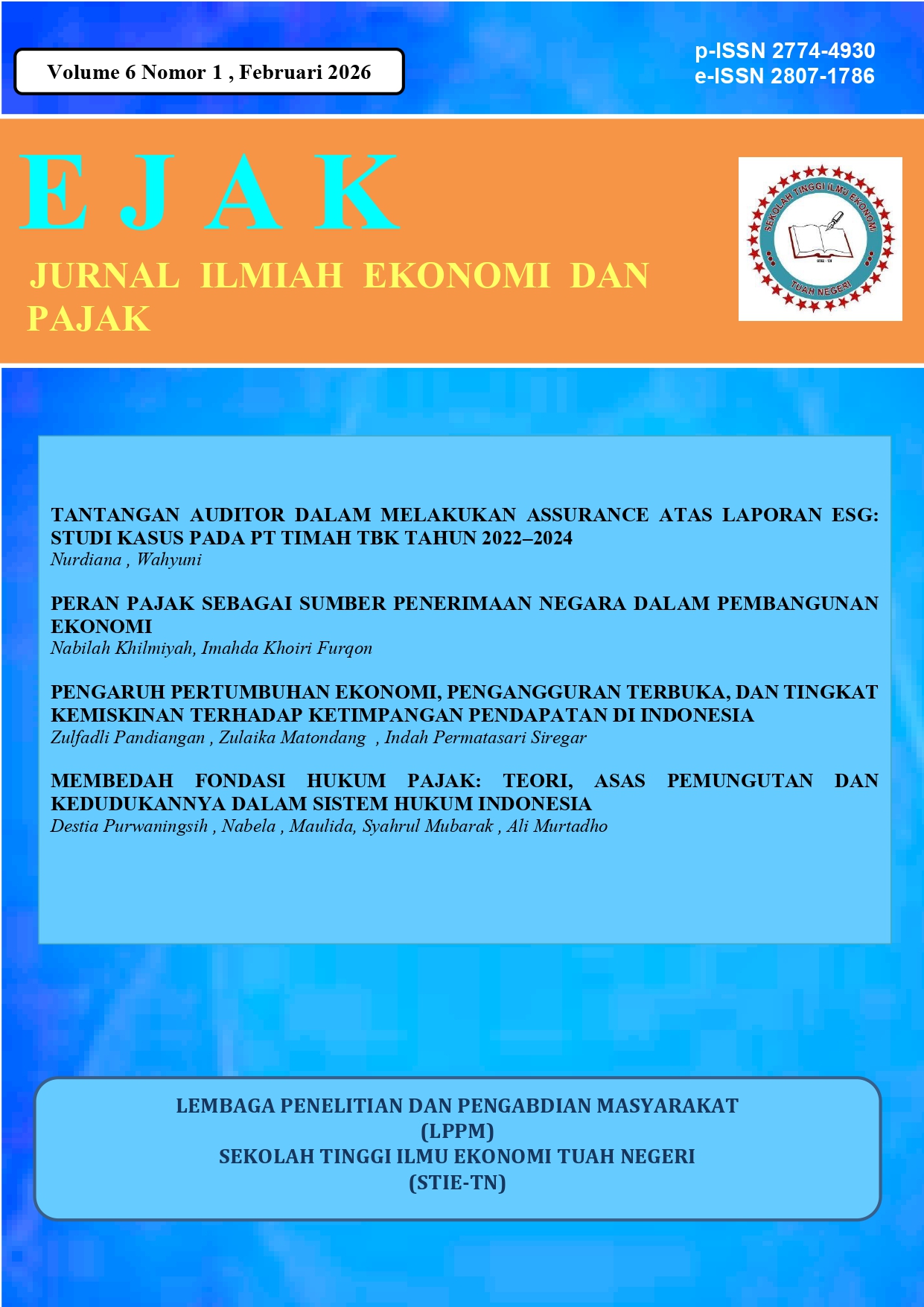
THE EFFECT OF ECONOMIC GROWTH, OPEN UNEMPLOYMENT, AND POVERTY RATE ON INCOME INEQUALITY IN INDONESIA
Keywords:
Economic Growth Unemployment Poverty Inequality IncomeAbstract
Income inequality in Indonesia reflects an unequal distribution of income among the population, commonly measured by the Gini ratio. This study aims to analyze the partial and simultaneous effects of economic growth, open unemployment, and poverty levels on income inequality in Indonesia during 2020–2024. This research employs a quantitative approach using panel data regression based on secondary data from the Central Bureau of Statistics (BPS) of Indonesia. The population consists of 38 provinces, with 8 provinces selected through purposive sampling. The Random Effect Model was identified as the best estimation model, and data analysis was conducted using EViews 13. The results show that economic growth, open unemployment, and poverty levels do not have a significant partial effect on income inequality in Indonesia. However, simultaneously, these variables have a significant effect on income inequality.
References
B. Atkinson, A., (2015), Inequality: What Can Be Done?, (Cambridge, MA: Hardvard University Press), 85-87.
Burki, A., Shirazi, K., dan Tahir, (2020), Labor Economics in an Islamic Framework: Theory and Practice, (Abingdon, UK: Routledge), 190-195
Chapra, M, U., (2016) Islam and the Economic Challenge, (Cet. X; Leicester: The Islamic Foundation 1992), 217-220.
D. Ostry, J., Loungani, P., & Berg, A., (2019), Confronting Inequality: How Societies Can Choose Inclusive Growth, (New York: Columbia University Press), 2-3.
Gai, A, M., dkk, (2024), Ekonomi Pembangunan, Teori Dan Praktik Dalam Mengatasi Ketimpangan Ekonomi Global, (Medan: PT Media Penerbit), 28.
Iqbal, M., (2018), Islamic Economic Institutions and the Elimination of Proverty (London: Kube Publishing).
Khaldun, I., (2017) Mukadimah Ibn Khaldun, (Jakarta: Pustaka Al-Kautsar), 25-27.
Matondang, Z., & Nasution, H, M., (2022), Praktik Analisis Data : Pengolahan Ekonometrika Dengan Eviews Dan SPSS (Medan: CV. Merdeka Kreasi Group), 25-151.
P. Todaro, M., & C. Smith, S., (2020), Economic Development 13 Edition, (United Kingdom: Pearson Education Limited), 229.
Rafli, M., 10 Provinsi dengan Ketimpangan Pendapatan Tertinggi 2024 https://data.goodstats.id/statistic/10-provinsi-dengan-ketimpangan-pendapatan-tertinggi-2024-7Uyhi (Diakses Tanggal 3 Januari 2025 Pukul 17.04 WIB).
Saputra, D, N., dkk., (2022), Buku Ajar Metodologi Penelitian, (Feniks Muda Sejahtera), 38.
Soesana, A., (2023) dkk, Metodologi Penelitian Kuantitatif, (t.t.,: Yayasan Kita Menulis), 57.
Sukirno, S., (2022) Makroekonomi Teori Pengantar Edisi ke III, (Depok: Rajawali Pers), 330.
Sugiyono (2024), Metodologi Penelitian Kuantitatif (Bandung: Alfabeta), 110.
Kahf, M., (2015), Islamic Economics: Theorical and Pratical Perspectives, Herndon, (International Institude of Islamic Thought, 2015), 2014-216.
Supriatin, D., dkk, (2022), Perekonomian Indonesia, (Jawa Tengah: Tiga Cakrawala), 87-88.
Zulkhibri, M., & Ismail, A, G., (2017), Financial Inclusion and Proverty Allevitation: Perspectives From Islamic Institutions and Instruments, (Cham: Macmillan), 3-5.
Downloads
Published
How to Cite
Issue
Section
License
Copyright (c) 2026 zulfadli pandiangan, Zulaika Matondang , Indah Permatasari Siregar

This work is licensed under a Creative Commons Attribution-ShareAlike 4.0 International License.
Privacy Statement
The names and email addresses entered in this journal site will be used exclusively for the stated purposes of this journal and will not be made available for any other purpose or to any other party.


